
Workshop

Views Navigation

Event Views Navigation

This Month

Calendar of Events

Latest Past Events

Rediseñar el trabajo

UCU Business School - Online Montevideo

En un mundo que exige nuevas formas de liderar, colaborar y organizar el trabajo, este workshop invita a empresarios y líderes a explorar cómo pasar de estructuras rígidas y centralizadas a organizaciones humanas, ágiles y resilientes. A partir de experiencias reales, como el modelo de equipos autogestionados de Bayer, y de una metodología participativa, los expertos suecos Alicia y Rolf Medina —autores del libro Organizaciones Humanas— brindarán inspiración, herramientas y caminos concretos para transformar la gestión, descentralizar el poder y liberar el potencial de las personas. Una experiencia única para quienes sienten que el cambio es urgente, pero aún no han encontrado el cómo. Contenidos: Nuevas formas de liderar y organizar el trabajo: fundamentos del modelo de poder distribuido y equipos autogestionados. Diagnóstico participativo: identificación de obstáculos, oportunidades y áreas clave para el cambio organizacional. Casos reales y tendencias internacionales: experiencias prácticas de transformación organizacional en empresas como Bayer. Herramientas y estrategias para el cambio: metodologías colaborativas, toma de decisiones descentralizada y liderazgo participativo. Plan de acción personalizado: guía para diseñar primeros pasos concretos hacia una organización más humana, resiliente y productiva.
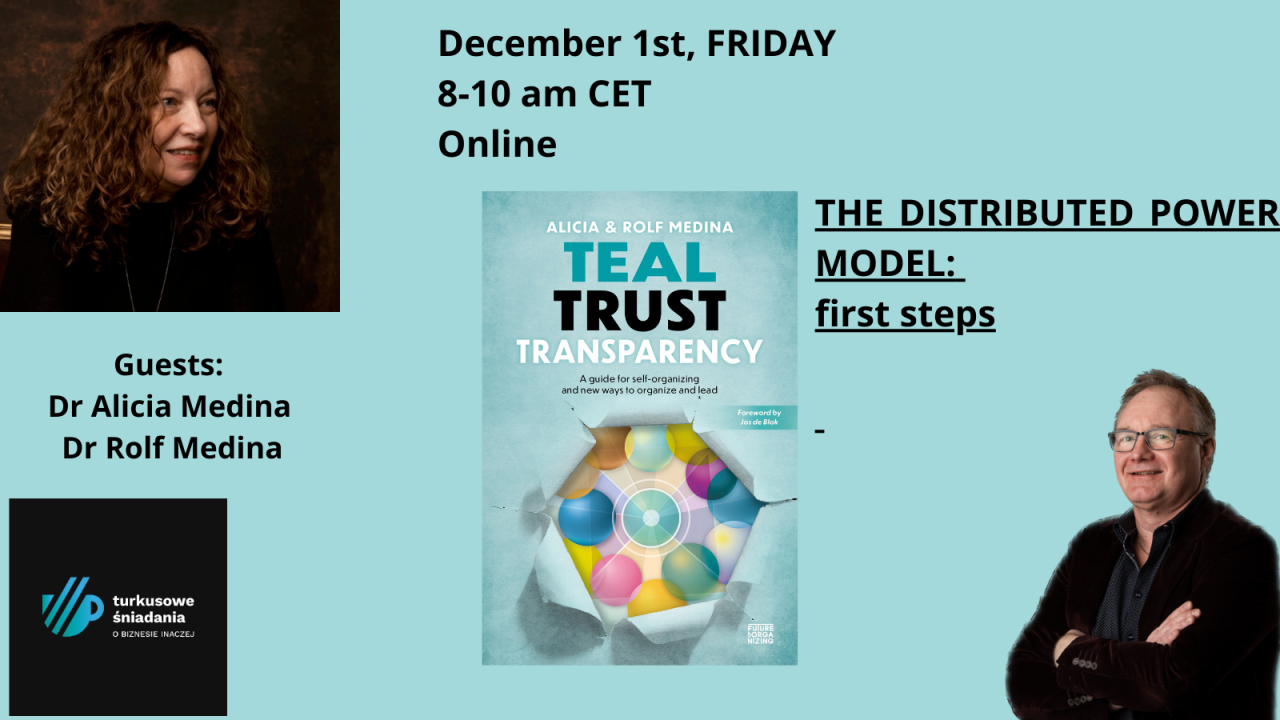
The Distributed Power Model: first steps

Online

Join us for the Teal Breakfasts workshop with Dr Alicia Medina and Dr Rolf Medina, researchers and consultants. They recently published a book "Teal, Trust, Transparency" (2023) where they presented the Distributed Power Model. We will be discussing one of the chapters from the book and sharing our thoughts and ideas of how to make first steps into the world of self-organizing. Click on this link to come to the registration The Distributed Power model is a systemic model consisting of 12 interconnected areas that can help organizations to implement the improvements or transformations that are needed to face the future and how to lead, organize, and collaborate in an organization based on self-organizing. The areas are People, Culture, Organizing, Leadership, Decision-making, Transparency and Communication, Salary model and Profit-sharing, Digital tools and Technology, Competence and Learning, Workplaces and Working Hours, Social Responsibility Sustainability, and Finances. The areas are circumscribed by a purpose that goes beyond profit and that needs to be defined at several levels: organizational, team and individual. The purpose needs to be accompanied by even over principles. The Distributed Power model is based on trust, respect, organizing work together, and seeing the organization as a whole, and is […]

The Swedish model of self-organizing

Online

A two-hour online event organized by Basku Metodas. What does it take for organizations to open up to the future and people in them to thrive? Alicia and Rolf Medina, PhDs in management and well-known business consultants in Sweden, spent three years researching modern organizations and management models, interviewed more than 300 people, studied over 100 companies and talked to dozens of world-class experts and researchers in the field. During their research, they met individuals in various countries around the world who, independently of each other, are creating radically better work environments and looking at organising and leading from a systemic perspective. They were looking for tangible and actionable realities to combine into a new model for our ever-evolving world. This is how the DP - Distributed Power - operating model of organizations was born. It covers 12 different areas that organizations need to consider in order to move into the future – some of those areas are people, culture, finance, reward system, and technology. This model is based on the insight that there is a global paradigm shift about how we perceive ourselves and our activities. The new paradigm means that organizations become human-cantered, and power is not concentrated […]